

Captain Edward Frederick Robert Bage: The Antarctic ANZAC
First World War
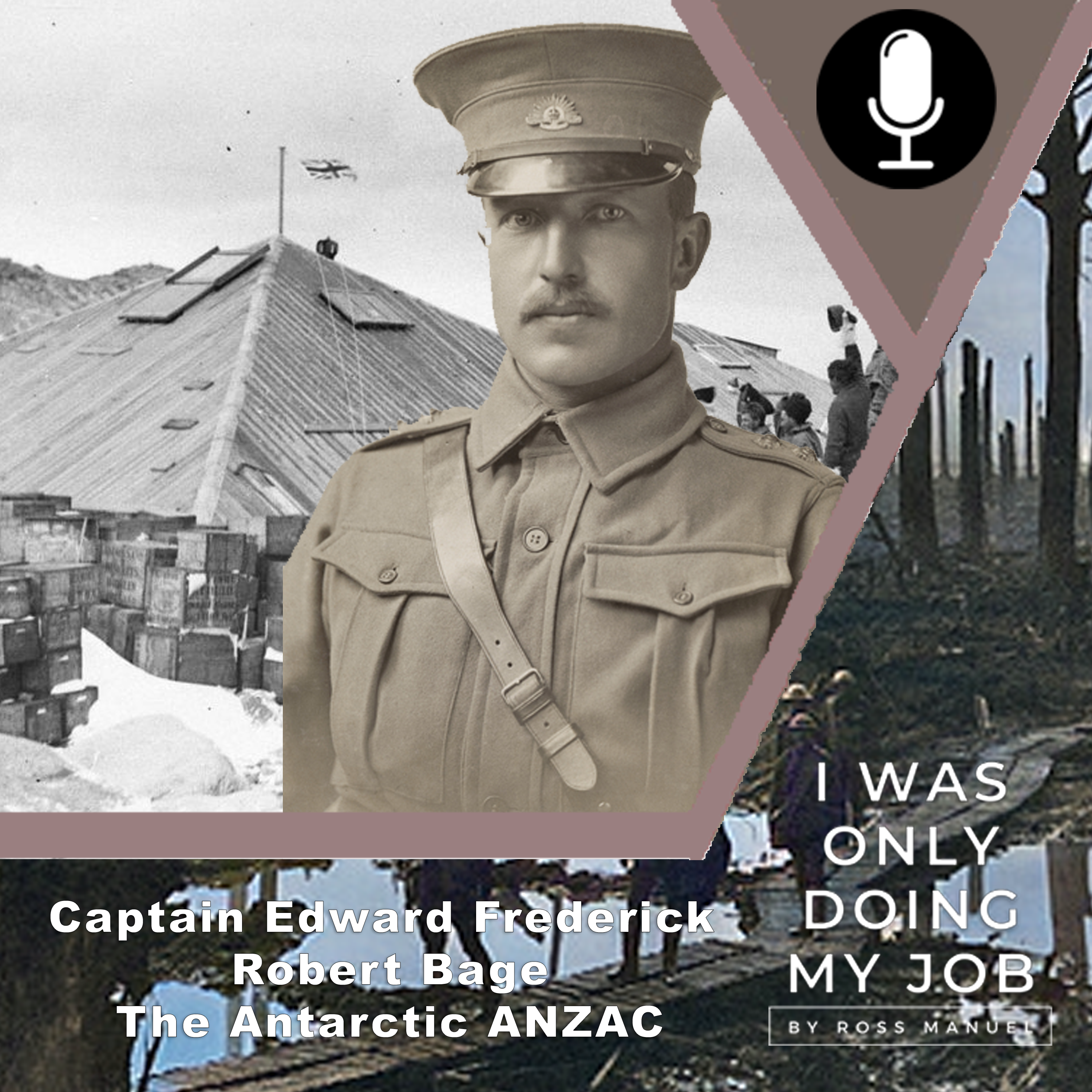
Captain Edward Frederick Robert Bage: The Antarctic ANZAC
Summary
7-MAY-1915. While serving as an engineer with the 3rd Field Company Engineers, Australian Imperial
Force, Captain Edward Bage was instructed to map out new trench locations on Gallipoli, and as a
result would be killed 14 days after landing on the Pennisula, but his legacy is not one of
the battlefield, but of Antarctic Exploration, when he spent two years mapping Antarctica alongside
Sir Douglas Mawson
—
Send in a voice message: https://anchor.fm/iwasonlydoingmyjob/message
Show Notes
Edward Frederick Robert Bage was born in St Kilda Victoria on 17 April 1888. Also known as "Bob Badget" he was the only son to Edward Bage a merchant and Mary Charlotte Lange, he would have two sisters Freda and Ethel.
He received his education at the Melbourne Church of England Grammar School in 1900, where he was awarded the Witherby Scholarship in 1901. Completing school in 1904 with honours in physics at matriculation. In 1905 he was awarded a Warden's Scholarship to Trinity College at the University of Melbourne, where he studied Engineering. He obtained first-class honours in Chemistry and won an Exhibition in Surveying in 1905, graduating with a Bachelor of Civil Engineering in 1910. While a student, he was constantly a fixture of the college social scene while also being the inaugural Secretary of the University of Melbourne Student Representative Council and rowed in the College eight at Trinity College.
Bage joined the militia in 1909 and enlisted as an officer at the rank of 2nd Lieutenant with the Royal Australian Engineers and was initially posted to Queensland for two years before being promoted to full Lieutenant at the start of 1911 and spent time assigned to the submarine mining station in Sydney, one part of the fixed defences of the port city, namely the maintenance, deployment and detonation of sea mines before taking up the same post in Melbourne.
In September, however, he requested leave from the Permanent Military Force to be engaged as Astronomer, Assistant Magnetician and Recorder of Tides for Douglas Mawson's Australasian Antarctic Expedition. He undertook a crash course in astronomy with Pietro Baracchi from the Melbourne Observatory, whose son, Guido, Bage knew from his time at Trinity College. On 22 November, a farewell dinner was held in his honour at Trinity, after which he left for Tasmania.
The Australasian Antarctic Expedition was a three-year survey mission headed by Sir Douglas Mawson, who most Australian’s who comprise my listener demographic would recognise as one of the faces on the old paper $100 bill from 1984-1996. The intent of this operation was to explore the largely uncharted Antarctic coast immediately to the south of Australia covering some 4,180 kilometres or 2,600 miles of unexplored iceshelfs mountains and crevasses. While its support ship the AY Aurora would chart 2,900 kilometres, 1,800 miles of coastline. While there the expedition would also conduct scientific experiments included meteorological measurements, magnetic observations, an expansive oceanographic program, and the collection of many biological and geological samples, including the discovery of the first meteorite found in Antarctica.
Mawson selected Bage in a party of six to accompany him on 9 January, landing at what he then named 'Commonwealth Bay', and then, on 19 January, the ship left eighteen men with 23 tons of equipment and two-years' worth of food.
The plan called for four separate parties who would travel out from base camp with specific objectives. Bage was assigned to command the Southern Party comprised of Bage, the New Zealand magnetician Eric Webb, and the photographer Frank Hurley, a man who would go on to immense fame as one of Australia’s Official Wartime photographers for both the First and Second World Wars – to head south on a 600-mile round trip to study the extent of the South Magnetic Pole region. There would also be expeditions along the coast on mapping missions or to specific previously observed landmarks. While there was no set objectives aside from this, all the parties had to return to base camp by the 15 January 1913 when the Aurora was expected to retrieve them.
Despite days on which due to severe snow blindness Bage had to be carried on one of the sledges hauled by the other men, the team managed to set a sledging record of 41.6 miles in one twenty-four-hour period. One of the men who had remained at the base camp, Charles Laseron, recorded that Bage's "quiet determination, resolution, and foresight carried them through ... always cheerful, ready with a hand to anybody who needed it ... he was a born leader of men".
When The Aurora returned to collect them, all bar one team had returned, the one led by expedition leader Douglas Mawson who had been tasked with reaching Oates Land, roughly 560 kilometres from their base camp. By 8 February, as the Aurora and the other teams waiting, Mawson's team was now four weeks overdue, and John Davis, officer in charge of the Aurora was forced to decide if the ship would stay and risk being frozen in, leaving a team to conduct a search or abandon Mawson and his team. the decision was made to leave a team to conduct a search and the Aurora would return when conditions improved: the six men chosen, including Bage, would have no choice but to weather another Antarctic winter before the ship could come back for them.
A mere matter of hours after the Aurora, Mawson appeared alone, suffering from severe sunburn, frostbite, and malnutrition. He was the sole survivor of his team.
Bage and the rescue team where able to signal the Aurora and it was able to return the following day, only to be prevented from reaching the survivors by the weather. After a week, Davis decided once again to leave; Mawson, Bage and the others spent another winter in Antarctica, with Bage acting as storeman.
The Aurora returned on 13 December 1913, and the expedition returned to Australia, landing in Adelaide, Mawson's home town, on 26 February 1914, after more than two years away to grand fanfare.
Considering the expedition was stuck in the Antarctic, Bage had requested an extension to his leave from the Army, which was understandably approved. When Bage re-joined his unit on 3 March 1914, and was posted to the Staff Office in Melbourne. As a member of the regular army, at the outbreak of war, Bage was mobilised immediately, with preliminary orders being released on 2 August. He was commissioned as a lieutenant in the First Australian Imperial Force, and second-in-command of the 3rd Field Company, Australian Engineers. Early in September he became engaged to Dorothy Scantlebury, who at the time was in her third year at university studying to become a teacher. Sadly the engagement would not result in wedded bliss as Bage would depart for the war on the 22 September aboard the troopship HMAT A2 Geelong, arriving in Alexandria on 10 December.
In February 1915, he was promoted to captain and was awarded the Polar Medal by George V.
Training continued until 3 April when the 3rd Field Company left for Lemnos, and then, on 24 April, departed in readiness for the Gallipoli landings. The engineers were among the first to reach the shore, preparing the area so that the infantry could land, building roads, creating gun emplacements, digging trenches, and establishing ammunition depots.
On 7 May, the commander of the 1st Australian Division, Major-General William Bridges, inspected the area near the 'Pimple', a salient at the southern end of the ANZAC lines, and devised a plan to take some of the Turkish trenches there. Bage's orders were to take a small party in support of Major Edmund Drake-Brockman of the 11th Battalion, and, in broad daylight, get to an exposed area about 150 yards beyond the front line and peg out the position of the new trench line so that the infantry could dig in that night. By accounts of engineers under his command, Bage did this knowing that he was probably not coming back, and considering his rank at this time, not a task that he himself had to undertake, but he knew it had to be done. Bage was caught in machine-gun fire from near Lone Pine and hit in several places; according to Sapper James Campbell “Went out like a very Gallant Gentleman” his body wasn’t able to be immediately recovered but he was buried in the Beach Cemetery above ANZAC Cove the following day.
Following his death, he was mentioned in Division files for Acts of conspicuous gallantry and valuable service, which was uncommon for those who had already been killed in action. His obituaries noted that he was "very popular among both officers and men", and that he was "an indefatigable worker, a thorough and efficient organiser, and one of the most promising of the younger officers of the permanent forces". Trinity held a memorial service for him on 19 June, at which "All members of the late solder's family were present". At the beginning of 1916, his mother donated £1,000 to the University of Melbourne for an Engineering scholarship in her son's memory, to the value of £40 per annum.
Dorothy Scantlebury would go on to become the principal of Toorak College, and spend a period of time in Kenya as part of the Civil Service, where she married a member of the Colonial office, and would pass away 21 August 1974.
Bage’s story is just one of the five men from Trinity College who lost their lives during the Gallipoli campaign, but because of his pre-war recognition, the best documented
References
ANZACS, ‘Anzac Individual Record - Capt. EFR Bage, AIF’, Anzacs.org, 2025. https://www.anzacs.org/pages/AObage.html
Australian National University, ‘Obituary - Edward Frederick Robert Bage - Obituaries Australia’, Anu.edu.au, 2025. https://oa.anu.edu.au/obituary/bage-edward-frederick-robert-15674
———, ‘Obituary - Marie Charlotte Bage - Obituaries Australia’, Anu.edu.au, 2025. https://oa.anu.edu.au/obituary/bage-marie-charlotte-15673
Australian War Memorial, ‘Fifty Australians - Bob Badget Bage | Australian War Memorial’, Australian War Memorial, february 5, 2020. https://www.awm.gov.au/visit/exhibitions/fiftyaustralians/2
———, ‘Places of Pride: Edward Frederick Robert Bage’, Places of Pride, Australian War Memorial, n.d. https://placesofpride.awm.gov.au/memorials/164946/captain-edward-frederick-robert-bage .
———, ‘Studio portrait of Lieutenant Edward Frederic Robert Bage, 3rd Field Company Australian Engineers’, Awm.gov.au, 2025. https://www.awm.gov.au/collection/C70700
National Archive of Australia, ‘Service Record of Edward Frederick Robert Bage’, Naa.gov.au, 2025. https://recordsearch.naa.gov.au/SearchNRetrieve/Interface/ViewImage.aspx?B=3044153
National Library of Australia, ‘[Robert Bage on board the S.Y. Aurora]’, Trove, National Library of Australia, 2025. https://nla.gov.au/nla.obj-141779860/view
———, ‘A Corner of the hut, Bage Mending His sleeping-bag’, Trove, National Library of Australia, 2025. http://nla.gov.au/nla.pic-vn3119846
———, ‘BAGE MEMORIAL SCHOLARSHIP. - The Argus (Melbourne, Vic. : 1848 - 1957) - 27 Jan 1916’, Trove, National Library of Australia, 2025. https://trove.nla.gov.au/newspaper/article/2104078?searchTerm=%22Edward%20Frederick%20Bage%22
Virtual War Memorial of Australia , ‘Edward Frederick Robert (Bob) BAGE’, Vwma.org.au, 2025. https://vwma.org.au/explore/people/109149
‘Edward Fredrick Robert Bage’, Fandom.com, 2025. https://military-history.fandom.com/wiki/Edward_Frederick_Robert_Bage?action=edit
‘Lt. Edward Frederick Robert Bage Biographical notes’, Coolantarctica.com, 2025. https://www.coolantarctica.com/Antarctica%20fact%20file/History/biography/bage_lt_Robert.php